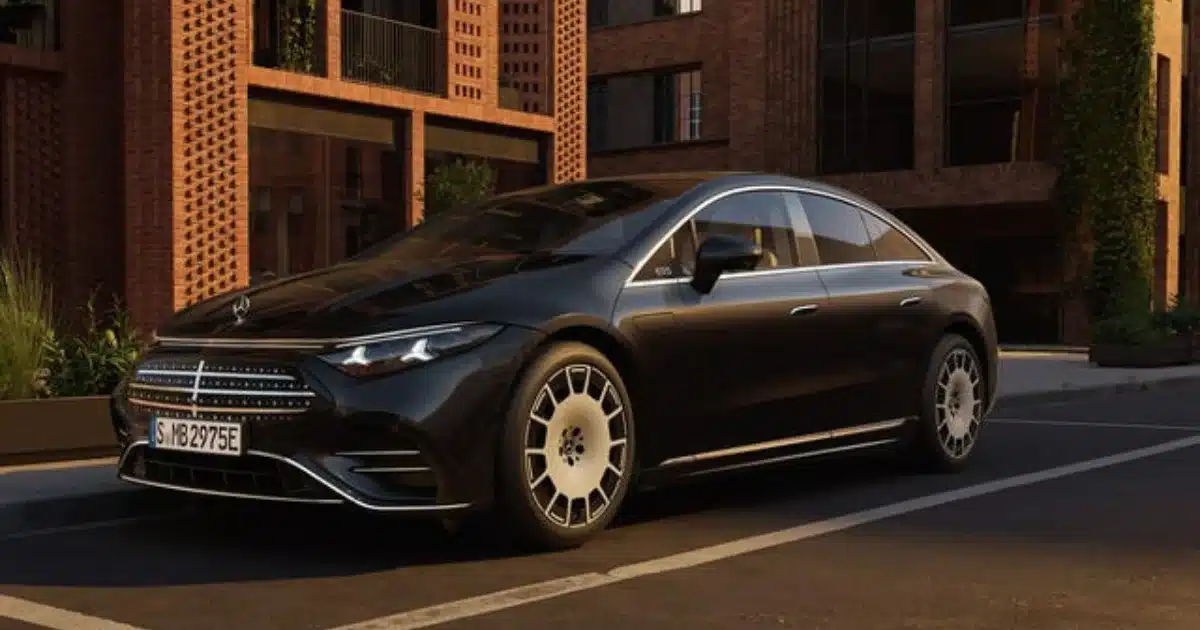
We’ll admit it: when we first got wind of Mercedes-Benz’s plans to refresh its flagship EQS sedan for 2027, we weren’t expecting much. Other manufacturers have stolen headlines with aggressive aerodynamic redesigns and radical powertrain tech, and Mercedes seemed poised to let its enormous flagship sedan coast on little more than its incredible name recognition. But look again, because the German automaker isn’t messing around.
Don’t get us wrong: at a glance, the new EQS doesn’t look all that different than its predecessor. Sure, there are new hood strakes, some subtle sheetmetal tweaks, and a bigger rear diffuser. But slip under the skin and the story changes dramatically. Mercedes has pulled some serious optimizations under the hood to position its flagship sedan to take on both the Lucid Air and even BMW’s recent entry into the luxury EV segment, the i7.

The big headline upgrade is the introduction of an 800-volt charging architecture. We know what you’re thinking: “Haven’t we been here before?” Patience, friend. It’s true that Mercedes was playing around with 800-volt tech a few years ago with its Vision EQXX concept, but it voluntarily shelved those plans back in the halcyon days of 2021. This new implementation actually sticks. It allows for charging cables about half the diameter of its predecessor, meaning the EQS can draw as much power as possible from 350-kW DC fast chargers.
Speaking of capacity, Mercedes actually tweaked the chemistry of its battery cells to increase power density. The physical pack isn’t any larger, but usable capacity now climbs to 122 kWh. Mercedes estimates this delivers up to 425 miles of EPA range—a notable improvement over last year’s roughly 390-mile maximum.
None of this would be possible without an all-new powertrain. Mercedes has ditched the EQS’s predecessor’s powertrain for a pair of in-house built electric motors. The rear motor is now paired to a two-speed transmission, with first gear serving double-duty as launch acceleration and low-speed maneuvering gear, and second gear activating for extra efficiency at highway speeds. Meanwhile, on 4Matic all-wheel-drive models, the front motor actually declutches itself when not in use to save precious energy.
This new drivetrain also changes how the EQS recovers energy when slowing down. Thanks to an updated regenerative braking system, the EQS captures an incredible 385 kW of power while decelerating. With that much grunt, most typical driving scenarios can be accomplished without ever applying pressure to the brake pads.
Last but certainly not least, Mercedes is offering an optional steer-by-wire yoke to replace the EQS’s traditional steering column and wheel. It’s been several decades since a car sold in the US last used a steering wheel yoke, so chances are this feels entirely foreign to you. Rest assured, it isn’t your great granddad’s yoke. This newfangled joystick features a variable steering ratio that requires drivers to move just 170 degrees to steer the EQS from lock to lock. Furthermore, the design is tapered enough that you’ll never need to reach across your body to steer.

Inside, Mercedes didn’t forget about the magic carpet ride its legendary Airmatic suspension has provided customers for decades. Now utilizing Cloud based Car-to-X data, the EQS can anticipate road conditions ahead of you by reading signals from the car ahead of you to better prepare your damper settings for whatever lies ahead. That holds doubly true for the MB.OS infotainment system, which Mercedes promises pulls up apps and functionalities near instantaneously. Those in the backseat also get bigger screens, as the rear monitors max out at 13.1 inches. And for those who just can’t seem to lose the winter weight, your new front seatbelts will warm up to 111 degrees to motivate you into taking that bulky coat off.

The new lineup includes the EQS450+, EQS500 4Matic, and EQS580 4Matic will launch toward the end of the year. Pricing has yet to be confirmed, but with so much next-generation tech under the skin, we’re guessing these cars will start about $2,000 higher than before at around $102,000 MSRP.