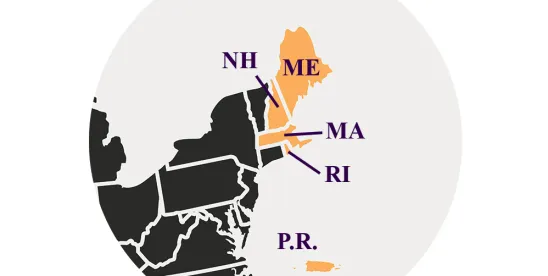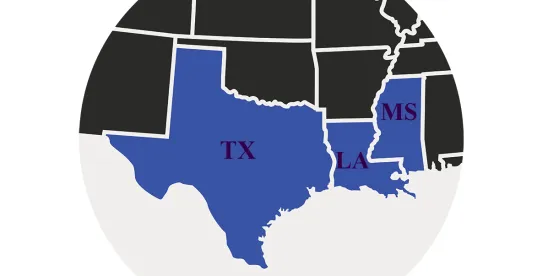
The Trump administration’s actions related to renewable energy development have suffered another setback. On April 21, 2026, US District Judge Denise J. Casper of the District of Massachusetts blocked a series of agency actions that imposed restrictions on renewable energy and stalled wind and solar developments across the country.[1] The court granted the motion for preliminary injunction filed by several regional clean energy organizations (Plaintiffs) against multiple federal agencies, including the Department of the Interior (DOI), the US Army Corps of Engineers (Corps) and the US Fish and Wildlife Service (USFWS). The Plaintiffs sought to enjoin five agency actions (Agency Actions) taken in response to Executive Orders 14156 and 14315 that established permitting pauses or imposed additional levels of regulatory review for solar and wind project applications. The challenged Agency Actions include:
- DOI’s July 15, 2025, memorandum establishing a three-level review process for wind and solar decisions culminating in review by the Secretary (DOI Review Procedures Memo);
- USFWS’s July 2025 decision to ban wind and solar projects from the IPaC website (a planning tool to streamline USFWS review) prior to a review process, including a final review by the Office of the Secretary;
- The August 1, 2025, DOI Secretarial Order No. 3438 that required DOI to review “reasonable project alternatives with higher capacity densities” to proposed energy projects (DOI Land Order);
- The Corps’ September 18, 2025, direction to consider energy density when processing permit applications for energy projects (Corps’ Memo); and
- DOI Solicitor Gregory Zerzan’s May 1, 2025, M-Opinion 37086 applying the OCSLA (p)(4) factors (Zerzan M-Opinion).
Drawing heavily from the District of Massachusetts’ decision enjoining agency actions implementing President Trump’s Wind Memorandum in State of New York v. Trump,[2] the court found that Plaintiffs were likely to succeed on the merits of their claims, established that their members are suffering or are likely to suffer irreparable harm as a result of the Agency Actions absent an injunction and found that the balance of equities weighed in favor of enjoining the Agency Actions.
Application of the Preliminary Injunction Factors
After concluding that the Plaintiffs had standing and that the Agency Actions were final, the court concluded that Plaintiffs are likely to succeed on the merits of their claims that four of the five challenged actions are arbitrary and capricious in violation of the Administrative Procedure Act (APA). The court found that DOI Review Procedures Memo, the Wind and Solar IPaC Ban, the Corps Memo and the Zerzan M-Opinion were likely arbitrary and capricious for several reasons, including lack of sufficient explanation or justification for each action and failure to point to distinctions between wind and solar projects and other types of projects warranting increased review or scrutiny for wind and solar. The court also found the DOI Land Order and the Zerzan Opinion were likely contrary to law, noting in part that both actions likely violated Section 8(p)(4) of OCSLA, which mandates consideration and balancing of 12 factors enumerated by the statute, not just those an agency deems important.
The court concluded that Plaintiffs are likely to suffer irreparable harm resulting from the Agency Actions. Rejecting the government’s argument that economic damages are insufficient to establish irreparable harm, the court stated that “there is no dispute that [Plaintiffs are] neither seeking nor able to recover monetary damages in this case,” and noted that there may be significant obstacles to the recovery of any monetary damages against the government.
Finally, the court found the balance of equities and the public interest weighed in favor of the Plaintiffs. The court stated that the potential harm to the power grid, public health, property rights and the environment outweighed harm to the agencies. While the agencies referenced the “intrusive effect” of an injunction on agency operations, the court countered by expressly stating that the agency defendants have “no interest in perpetuating unlawful agency practices that do not comply with the APA.”
Relief Awarded and Implications
The Court has granted Plaintiffs’ request to preliminarily enjoin the agencies from implementing or otherwise giving effect to the Agency Actions with respect to all members of the regional organizations. It remains to be seen whether the relief afforded by the court will result in meaningful progress for project developers whose applications are currently stalled before federal agencies. Federal agencies continue to retain considerable discretion over how to process applications. Moreover, the RENEW Northeast opinion relies heavily on the State of New York v. Trump opinion issued by Judge Saris of the District of Massachusetts in December 2025, which the government has appealed to the US Court of Appeals for the First Circuit. The First Circuit’s decision on appeal may affect the durability of RENEW Northeast opinion.
The RENEW Northeast decision may impact the government’s position in other cases challenging permitted offshore wind projects. For example, in ACK for Whales v. U.S. Department of Commerce, a proceeding challenging DOI’s approval for the New England Wind offshore wind project, the government moved to remand its earlier approval for the project, relying solely on the Zerzan M-Opinion.[3] On April 24, 2026, the court held the motion in abeyance to allow the government to determine whether it still would pursue remand. The government has sought voluntary remand in other cases challenging approvals for offshore wind projects, and to the extent such efforts rely on the enjoined Zerzan M-Opinion, such remand efforts are in question.
[1] RENEW Northeast v. Dept. of Interior, No. 25-CV-13961-DJC, 2026 WL 1078282 (D. Mass. Apr. 21, 2026).
[2] See New York v. Trump, 811 F. Supp. 3d 215, 233-34 (D. Mass. 2025) (blocking implementation of Presidential Memorandum, Temporary Withdrawal of All Areas on the Outer Continental Shelf from Offshore Wind Leasing and Review of the Federal Government’s Leasing and Permitting Practices for Wind Projects (Jan. 20, 2025) (Wind Memorandum)).
[3] 25-cv-01678-AHA (D.D.C.).