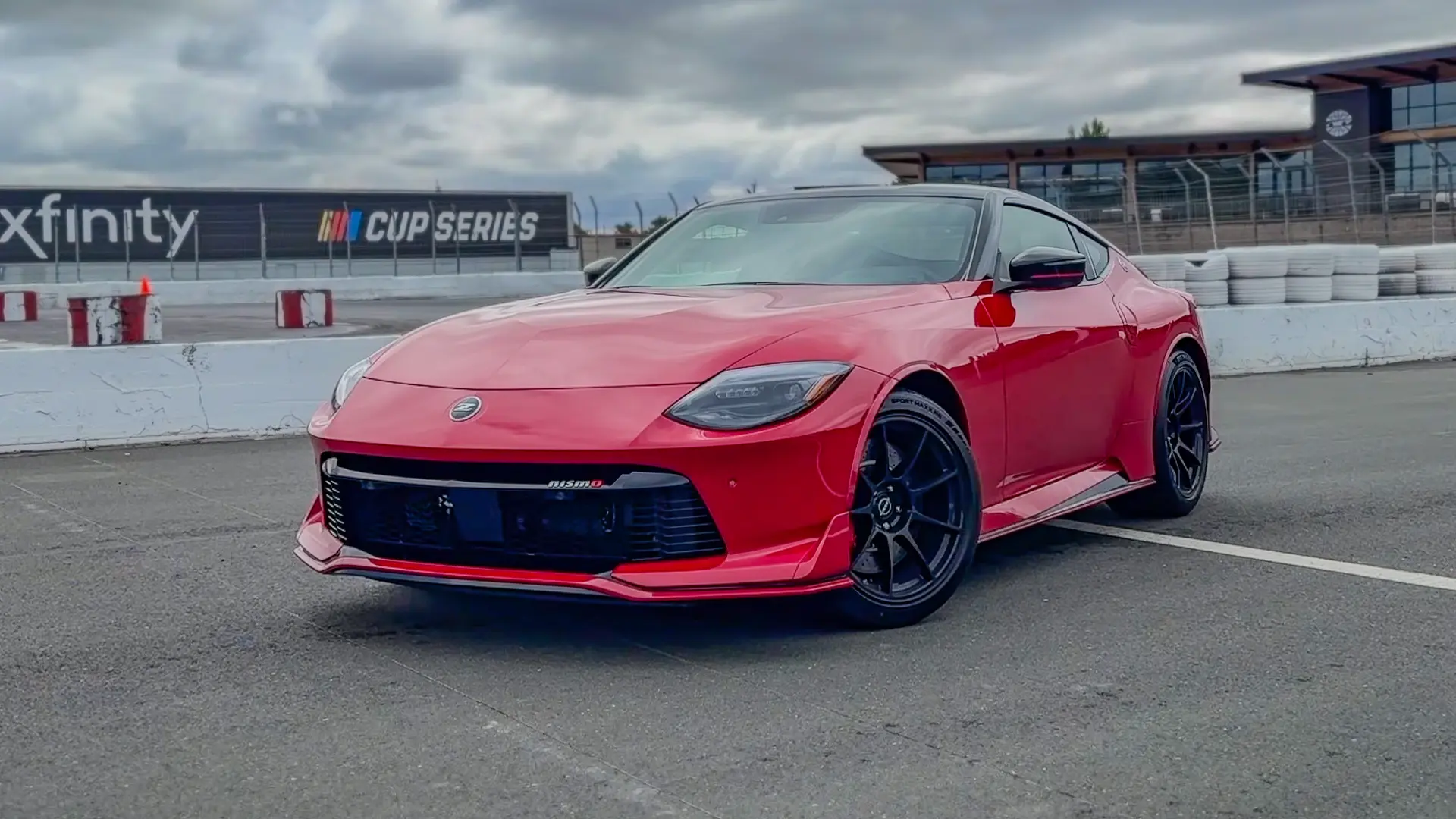

In this video, Tommy takes a closer look at the 2027 Nissan Z Nismo.
The Internet has now had the past four-and-a-bit years to argue about the latest Nissan Z. While the Toyota Supra also has its points of controversy, social media has been abuzz with all the ways Nissan got this generation wrong. In the video below, Tommy takes a closer look at something that’s finally coming to the top-end Nismo model — a manual transmission — and debunks some of the biggest myths we think folks got wrong about the latest Z car.
5) It’s too expensive…
At first brush, you’d be forgiven for thinking the Nissan Z is this super expensive sports car only meant for the most die-hard enthusiasts. If you look at the Nismo, it’s tough to argue, considering that model starts at a fairly eye-watering $67,045. However, it’s worth noting the base Nissan Z Sport, with a 400 horsepower twin-turbo V6 and a manual transmission, is available for $44,265 (including destination). That’s nearly $23,000 less for what is, still, a rear-wheel drive sports car. Not to mention, it’s also nearly $15,000 less than the least expensive Toyota Supra you can buy right now (and for a limited time, since the Supra is going away).
While the Ford Mustang GT offers up a 480-horsepower V8 option with relatively few other features for around that upper-$40,000 price point, the Nissan Z does still bring a fair bit of performance for the cash. And if you want to split the difference between the base Sport and the Nismo, you can opt for the Nissan Z Performance, which brings some added features like a mechanical limited-slip differential and beefier brakes.

4) Is the Nismo really that different, anyway?
In sticking with that price point for a moment, that delta is pretty huge for a car that, at first glance, doesn’t seem all that different to the standard Z. Sure, you get the red Nismo accents and the Recaro seats and a little more power, but that’s surely not enough to justify a price tag in the mid-$60Ks?
Well, Nissan contends there’s a lot more at play to make the Z Nismo a proper track-ready car, above and beyond the Sport or Performance trims. The brakes still use the Akebono calipers, for example, but there are now two-piece rotors from the GT-R in the equation. That improves temperature management in track runs, reducing brake fade. The extra 20 horsepower (420 horsepower) over the standard Z also incorporates features like independent ignition timing for each cylinder, as well as beefier cooling. The Z Nismo also brings a bit more torque (at 384 lb-ft) over the regular car.
3) “There’s no manual transmission for the Nismo!”
Okay, this one is more of a retrospective “the Internet got it wrong”, because Nissan indeed launched the Z Nismo without a three-pedal option. A lot of folks grumbled about that, and I’ll jump in and disclose that I was absolutely one of those people. Now, for 2027, you can get a 6-speed Z Nismo, with Nissan saying: “We made this car for the people who kept asking for this. If you want it, we will make it.” So good, there’s some proof here that pressure actually works.
More to the point, this is not the same manual transmission that is in the standard Z. This setup has a higher-tolerance pressure plate to handle the extra torque, and Nissan made some changes to the transmission housing. For the Nismo, the development engineers also incorporated a shorter shift throw so the manual feels better to use than the regular car (although, speaking from personal experience, it was already pretty good there too). The throttle mapping and steering feel is also switched up, so there’s a more direct and sporting experience.
2) Production issues aside, dealers really screwed this launch
This one’s not so much a debunk, as it is an acknowledgement that holy hell, was it tough to get your hands on the Nissan Z when it first rolled out. The automaker obviously took some time to ramp into production. Dealers didn’t help this car’s case, and that’s putting it mildly. When you take an ostensibly $50,000 sports car and tack the same price on again as a so-called “market adjustment” due to high demand, that’s going to have a cooling effect on folks actually taking one home, by and large.
Now, apart from folks shaming the dealers that engaged in ludicrous markup into oblivion, prices in general have more or less come back down to Earth with the Z. Most examples are at or slightly under MSRP, and while we don’t have official 2027 pricing just yet, hopefully both the manufacturer and dealers will keep this latest Z in line with what we’ve seen over the past year or two.

1) Is it just a warmed-over 370Z? This new car is still something special
After the sixth-generation 370Z, Nissan’s move to the “RZ34” as a modification of the old car’s platform rankled some enthusiasts. This seventh-generation model does carry over some points from that old car. Indeed, Nissan’s FM platform underpinned both the 370Z and 370Z, to say nothing of the host of Infinitis that use the same “Front Midship” architecture.
Our counterpoint to that is that, particularly against the likes of the Toyota GR86 and Supra, for example, this sports car is all-Nissan. In the modern age, we’re looking at a lot of cross-pollination between vehicles on the same platform, and it’s rarer that “all-new” vehicles are indeed all-new, just from a cost effectiveness point of view. With rear-wheel drive sports coupes, especially, it’s exceptionally rare to see a completely new, clean-sheet, ground-up car, as newer versions of older models (like the Ford Mustang, as another example) pull lessons learned from past generations.
In the Z’s case, we’re talking about a sports car that does have a completely different powertrain setup (i.e. the 400/420-hp twin-turbo 3.0-liter V6) than the old car. Bits of the interior may be the same, but you do still get physical buttons and some mechanical dials and a generally special feeling car. If you’re any automaker these days, you can’t blow the bank developing a relatively low-volume car (not if you want to stay in business, at least), so Nissan’s case is that it invested where folks wanted to create this latest generation. And, given Nissan’s own financial situation and the industry as a whole, it’s a good thing we still have a Z car as an option in the first place.