The U.S. Food and Drug Administration announced on May 12, 2026, “two decisive actions focused on food chemical safety.” First, FDA released two final documents for its new proactive food chemical safety post-market assessment program. Second, FDA launched reassessments of butylated hydroxytoluene (BHT) and azodicarbonamide (ADA), “chemical additives commonly used in a variety of food products.” As part of the reassessment, FDA issued two requests for information regarding the use and safety of these chemicals in food.
Food Chemical Safety Post-Market Assessment Program
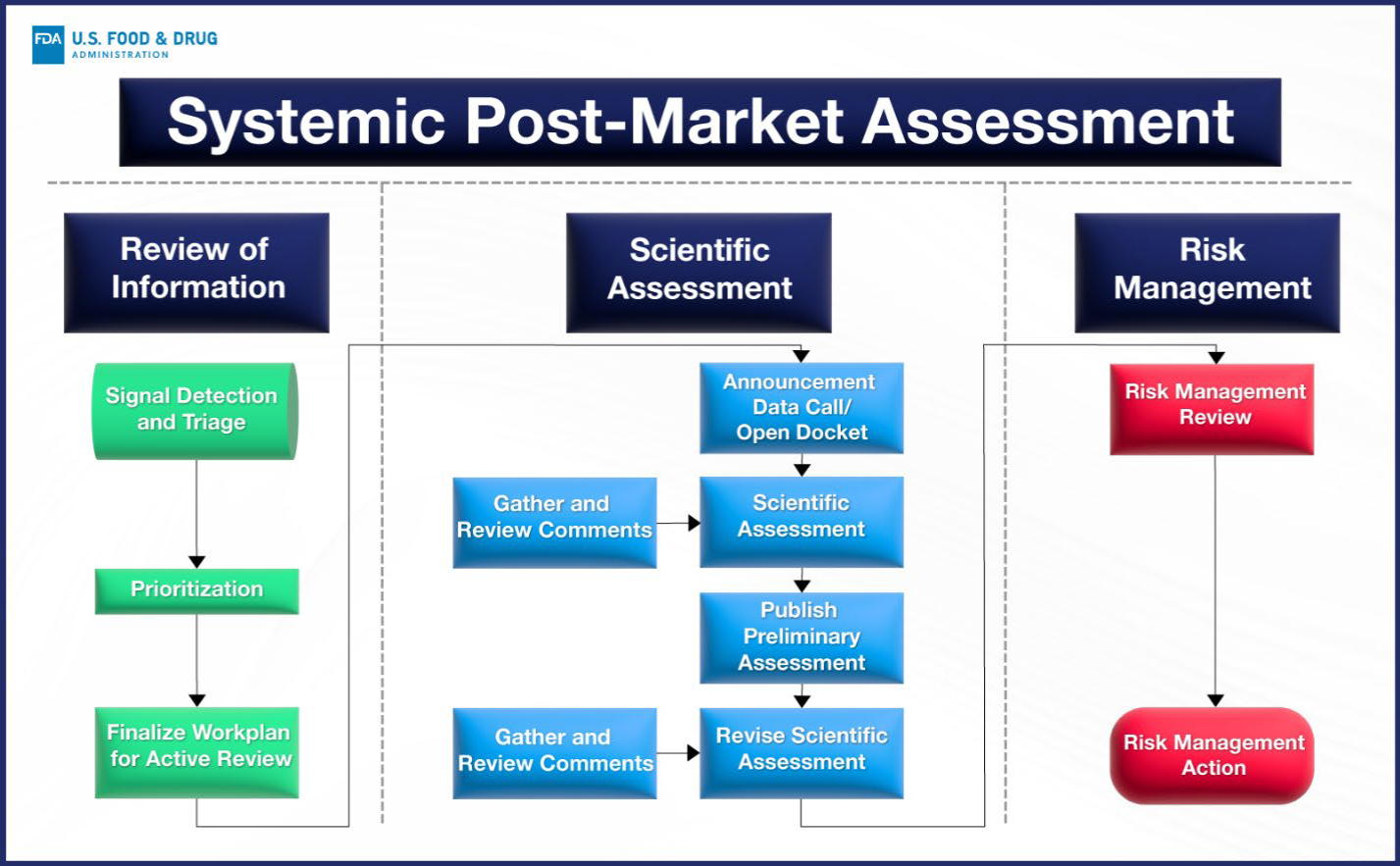
According to FDA, the two new documents will guide its annual food chemical post-market assessment plan. The first document, “The Enhanced Systematic Process for FDA’s Post-Market Assessment of Chemicals in Food,” describes how FDA will monitor and triage signals that provide information on hazards, use, or exposure related to food chemicals, then prioritize for assessment, evaluate, and manage these chemicals in the food supply. FDA states that, based on public comment, it streamlined this process, incorporating additional public engagement opportunities and providing additional details regarding how it will receive and identify potential safety signals, triage signals to determine how they should be handled, and how scientific assessments will be communicated to the public. FDA provides the following high-level overview of its Systematic Post-Market Assessment Process:
The second document, “Tool for the Prioritization of Food Chemicals for Post-Market Assessment,” helps identify priority food chemicals for full scientific assessment by focusing on potential risk to public health. FDA states that based on public comment and external scientific peer review, it modified its previously proposed method for ranking chemicals for assessment, including streamlining decisional criteria and scoring to focus on public health outcomes and increasing clarity on how the prioritization tool fits into FDA’s overall systematic process. For public health criteria, a chemical that would receive the highest score is one for which:
- The chemical may produce severe health effects (e.g., cancer, cardiovascular toxicity);
- Dietary exposure to the chemical has increased;
- The chemical is found in or could potentially be present in food intended for susceptible subpopulations (e.g., infants); and
- Newly available information, data, or science could potentially impact or change conclusions.
Reassessments of BHT and ADA
According to FDA, BHT is used to prevent spoilage of fats and oils and can be found in various food products, including breakfast cereals, frozen pizza, frozen meals, baking mixes, cookies, chewing gum, and meat products. FDA states that ADA is used as a whitening agent in cereal flour and as a dough conditioner in breadmaking and has applications in manufacturing food contact materials. FDA published requests for information (RFI) for BHT and ADA on May 13, 2026. 91 Fed. Reg. 27054, 91 Fed. Reg. 27060. FDA encourages food manufacturers, researchers, and consumers to submit relevant data and information. Responses are due July 13, 2026.
Commentary
The final post-market review process reflects needed improvements. The additional opportunities for public engagement are welcomed, as is the elimination of the distinction between “focused” and “comprehensive” assessments. Under the final document, the process will be dictated by the amount of data available for a chemical under review and the uses of the chemical, including use as a food or food contact material. This makes sense as the draft process struggled to distinguish meaningful differences between the assessment categories. In addition, the final process includes the option to peer review preliminary scientific assessments, an important feature to assure scientific integrity.
BHT and ADA are additives used in a wide variety of food products. Both have been the subject of considerable international and domestic scrutiny for years. For example, food additive uses of ADA have been banned in the European Union since 2005. The European Food Safety Authority concluded in 2005 that ADA in food was associated with adverse human health effects.
FDA’s decision to initiate reassessments of BHT and ADA aligns with Secretary Kennedy’s Make America Healthy Again (MAHA) agenda. A key goal of that agenda is to ensure chemical food additives meet “gold standard” science. BHT was called out in the MAHA Report as an example of a food chemical associated with adverse health effects in rodent studies.
Stakeholders are urged to monitor these developments carefully.