Article Summary
- The 2027 BMW X5 G65 is the first X5 on a modified CLAR platform and the first Neue Klasse vehicle to carry an internal combustion engine, offered in five powertrain variants at launch.
- The X5 50e plug-in hybrid delivers approximately 60 miles of EV-only range and transitions between electric and combustion power so seamlessly that the display is the only way to track it.
- Despite a 600 kg weight gap between the lightest and heaviest G65 variants, all three cars we drove felt consistent in character — the iX5 60, at 578 hp, being the most surprising of all.
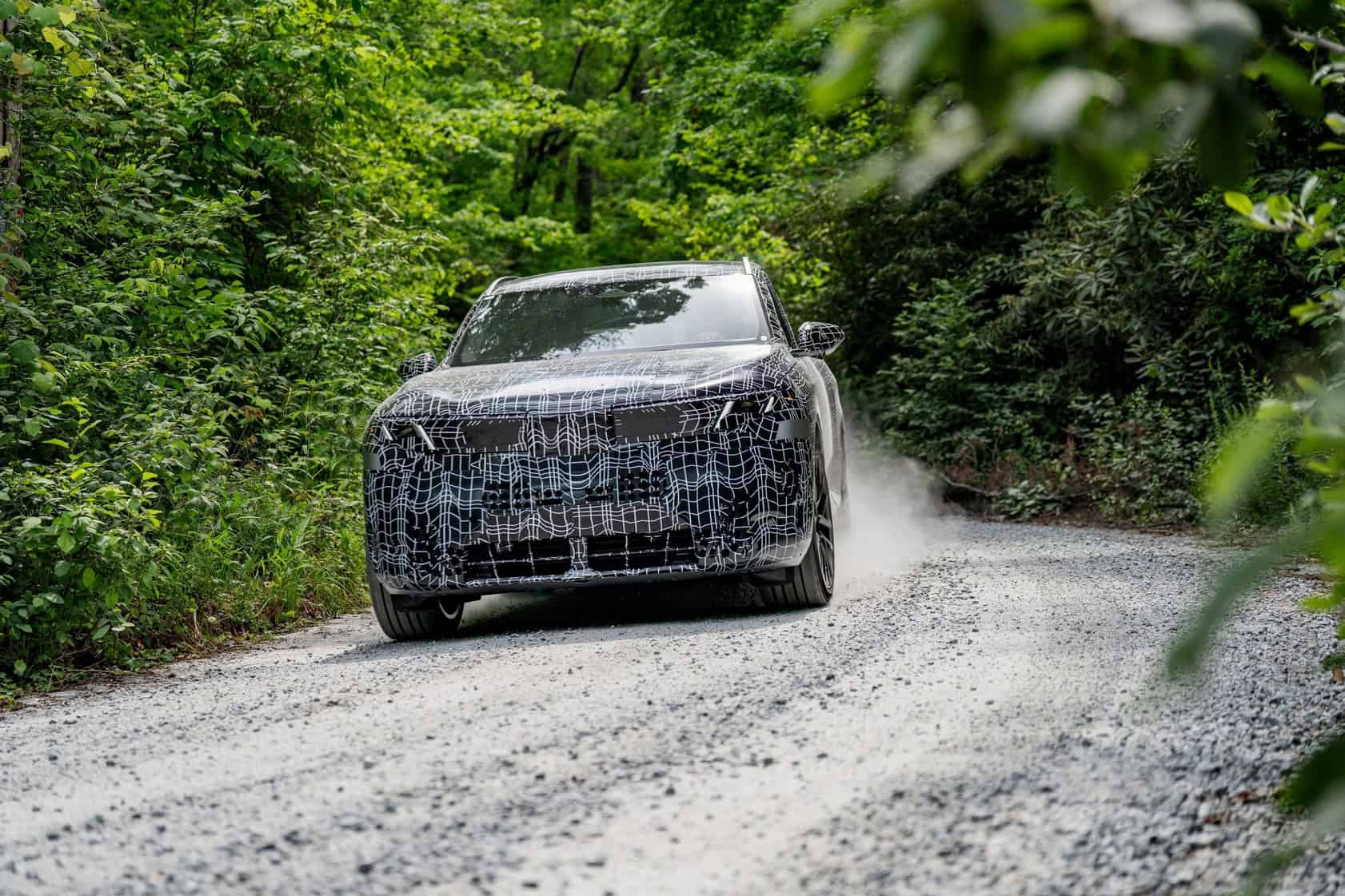
Spartanburg, South Carolina, is BMW’s American heartland. Plant Spartanburg has built X5s since 1999, and it is fitting that the fifth generation — the G65 — is being born in the same place. The BMW Performance Center sits on the edge of the plant, a dedicated driving facility with a handling course, a wet circle, a slalom track, and access to the surrounding mountain roads. It is here that BMW invited a small group of media to sample the new X5 before its public unveil, still wearing full camouflage, still technically a prototype.
This kind of pre-production drive serves a specific purpose. With the car weeks away from reveal and months from series production, the fundamental engineering is set — the platform, the powertrains, the chassis architecture are not changing. What remains adjustable is the finer layer: software calibration, damping curves, powertrain response mapping. BMW’s engineers were here partly to observe reactions and gather feedback that could still, in theory, influence those last details. In practice, the car we drove already felt finished.
The G65 X5 is the fifth generation of BMW’s best-selling model globally, with 3.1 million units sold across the four previous generations. It is also the most ambitious X5 to date: the first to sit on a modified CLAR platform, and the first Neue Klasse vehicle to carry an internal combustion engine. At launch, it offers five powertrains — a 48V mild-hybrid petrol, a plug-in hybrid, a diesel, a full battery-electric, and a hydrogen fuel cell variant due in 2028. We drove three of them: the X5 50e xDrive plug-in hybrid, the X5 40 xDrive petrol, and the iX5 60 xDrive electric.
Good
- Seamless ICE-to-electric transition in the 50e — best BMW PHEV yet
- An improved steering wheel across the lineup
- Consistent driving character across all five powertrains despite a 600 kg weight spread
Bad
- Wide A-pillars might create blind spots at junctions
- The iX5 is a heavy car
- Lack of many physical buttons
The Platform Story

Understanding what changed underneath the G65 explains a lot of what you feel when you drive it. The Heart of Joy (Dynamic Performance Control) — BMW’s new integrated chassis management system, carried directly from Neue Klasse — processes steering, damping, torque distribution, and brake regen inputs ten times faster than the outgoing system. The result is simply a car that feels more immediate and more precise than its predecessor, without feeling nervous.
The suspension architecture was rebuilt to handle an unusual engineering problem. The G65 has to accommodate a weight range of approximately 600 kilograms between the lightest petrol variant and the heaviest full-electric iX5 — while sharing the same body, the same suspension pickup points, and the same fundamental chassis geometry across all five powertrains. BMW’s answer was to separate the spring and damper mounting, which had been combined in the outgoing G05 X5, pushing the dampers further outward for better roll control and fitting larger progressive springs that can handle the load spread more effectively. The front axle also received revised kinematics, specifically targeting the small dead zone on steering center that was a characteristic — if rarely discussed — trait of the G05.
Wheels run from 21 to 23 inches across the range. BMW developed specific tire specifications for the G65 rather than adapting existing items, targeting lower rolling resistance without sacrificing ride quality or noise. The result, on the roads around Spartanburg, was impressive: 22-inch wheels on rough tarmac absorbed impacts with very little reaching the cabin, and highway noise at 60 mph was minimal enough to be genuinely surprising.
X5 50e xDrive — The Plug-In That Drives Like A Proper BMW

We started the day in the X5 50e xDrive, BMW’s plug-in hybrid and the variant most US buyers are likely to choose. It pairs a turbocharged inline-six with a sixth-generation electric motor integrated into the eight-speed automatic, producing a combined output of 360 kW — 490 horsepower — in peak mode. The battery is 25.7 kWh, which BMW says delivers approximately 102 kilometers, or about 60 miles, of electric-only range on the WLTP cycle. For reference, the average American drives around 32 miles per day. That means most daily use in the 50e happens entirely on electric power, with the petrol engine serving as a long-range backstop rather than a constant presence.
The first thing to understand about the 50e is that the powertrain story is not really about the numbers — it is about the calibration. BMW rewrote the operation strategy for the hybrid system four years ago, integrating the combustion engine’s startup cues directly into the sixth-generation electric architecture. In practice, that work produces a PHEV that behaves like one vehicle rather than two systems sharing a car.
In Personal mode, the power display bars stay blue — electric only — through normal urban driving, transitioning to white as the petrol engine wakes up under harder acceleration. The transition itself is imperceptible. There is no pulse through the throttle pedal, no vibration through the chassis, no moment of recalibration. The exhaust note changes slightly under load, and that is the only indication the engine has started. Earlier BMW PHEVs required the driver to watch the display to track what was happening; in the G65 50e, watching the display is the only way to know.

On the Performance Center’s handling course, the 50e feels significantly more composed than a car of this size and weight has any right to. Body roll is well controlled without feeling artificially flat. Turn-in is prompt. The rear axle tracks faithfully under cornering load. Launch control — activated in Sport mode with the stability system in DTC — produces a hard, straight-line run with shifts that feel deliberate and precise rather than frantic. BMW has not confirmed final 0-62 mph figures, but provisional data points to the low four-second range.
The Efficient mode is worth exploring beyond the name. Activating it trims HVAC output, reduces lighting loads, and starts coaching the driver to lift earlier before corners and traffic using the navigation map. The effect on range is measurable: the air conditioning draw dropped from 3.7 kWh to 1.5 kWh the moment the system reduced climate output — a swing of more than two kilowatt-hours from a mode most owners will never investigate past its label.
For drivers who want maximum electric range without the complexity of mode-switching, a Moment Electric function locks the car into EV-only operation up to 140 km/h. For drivers who need immediate full power from any mode, pulling the right-hand paddle fires the combustion engine instantly and delivers peak output on demand. Both features existed in previous BMW PHEVs in various forms; here they are simpler to use and more responsive in execution.
X5 40 xDrive — The Entry Point That Doesn’t Feel Like One

After the Performance Center exercises, we headed onto the South Carolina mountain roads in the X5 40 xDrive. The 40 is the petrol-only entry point of the G65 range, producing 294 kW — 400 horsepower — from the B58 inline-six with 48V mild hybrid assistance. Our test car ran steel spring suspension rather than air; active rear steering and active roll stabilization, available on upper variants, were absent. This is the G65 with the least electronic assistance, which made it the most revealing car to assess.
The steering improvement is the story here. The G05 X5 had a small but persistent dead zone on center — a couple of degrees of rotation where the feedback softened before picking back up. It was not dramatic, but on a winding road you noticed it and kept noticing it. The G65’s front axle received revised pickup points, new compliance geometry, and a better stabilizer linkage ratio specifically to fix this. On the mountain roads around Spartanburg, the result is a steering rack that responds immediately off center and delivers consistent, calibrated feedback throughout the corner. Not heavy, not artificial — just accurate. You feel the road through the wheel, which on a large luxury SUV is not a given. Is it perfect? No. There is still a lack of real feedback, but that’s usually a pet peeve of most journalists and not of real customers.
The gearbox is also meaningfully improved. The eight-speed in the G05 was never a problem, but its shifts had a slight softness that sat slightly out of step with the rest of the car’s character. The G65 X5 shifts more crisply in automatic and holds a selected gear at the limiter in manual-paddle mode rather than upshifting on your behalf. Again, a small thing and largely not perceivable in real day driving.
With 22-inch wheels on rough tarmac, the new BMW X5 40 xDrive absorbs impacts with little drama. The separated spring and damper arrangement pays dividends even without the sport suspension and active systems of the upper variants — the body stays composed, the tires maintain contact, and the car’s attitude through a corner sequence is stable and predictable. The X5 40 all-wheel drives, in short, like a BMW should. That sounds like faint praise for what is supposed to be the most basic variant, but given the direction recent X5 generations have taken — progressively quieter, heavier, and more insulated — it is worth saying plainly: the G65 40 xDrive is the most driver-connected X5 in several years.
iX5 60 xDrive — The Electric That Doesn’t Feel Electric

The iX5 60 xDrive is the G65 in its most extreme form. It uses BMW’s sixth-generation eDrive technology on an 800V architecture — the voltage level that allows faster charging and more efficient power delivery — with cylindrical battery cells, the format that Tesla has used for years and that most of the industry has now adopted. The battery is 144 kWh usable in the US (141 kWh in Europe), which BMW confirms is the largest high-voltage pack it has put in any production model. Two motors produce a combined 425 kW — 578 horsepower — and xDrive all-wheel drive is standard.
It is also, by a considerable margin, the heaviest X5 ever built. The weight difference between the lightest G65 and the iX5 is approximately 600 kilograms — more than 1,300 pounds. The iX5 comes with air suspension, electronically controlled adaptive dampers, active rear steering, and active roll stabilization as standard. All of that hardware is working harder than it appears to, but it still feels a bit heavy when pushed hard. For normal driving, the weight shouldn’t be an issue.
The battery pack sits in the floor, which lowers the center of gravity compared to any previous X5. BMW deliberately calibrated a small amount of residual body roll into the setup rather than eliminating it entirely — their reasoning being that a perfectly flat car loses the feedback cues that tell the driver what the tires are doing. In corners, the iX5 leans just enough to feel natural, settles quickly, and communicates grip and load consistently. Driven back-to-back with the 40i on the same roads, the weight difference was impossible to identify from behind the wheel.
The one-pedal driving system has been substantially improved from what was in the G05 X5 and, more relevant to the comparison, the iX. The adaptive regeneration now integrates navigation data, forward camera information, and traffic conditions to select the appropriate regen level before the driver needs it — slowing the car ahead of red lights and junctions rather than responding to brake input. At a stop sign on the mountain roads, the car came to a complete rest without the small jerk at the very end that has been a characteristic of BMW’s electrics and PHEVs for years. BMW calls this the soft stop: using the electric motor to smooth the final deceleration rather than letting the friction brakes handle it. It is a detail that sounds minor until you live with it, at which point it changes the texture of every low-speed situation.
Cabin noise deserves mention. On a wet concrete highway at 60 mph, the most audible thing inside the iX5 was rain on the windshield. Active noise cancellation handles road frequencies; revised door mirror geometry, specifically redesigned to address the wind buffeting that attracted complaints on the G05 X5, handles wind intrusion. BMW describes the G65 as the quietest X5 yet. On the evidence of our drive, that is accurate.
The Symbiotic Drive ADAS system, in its most complete form here, can handle steering, acceleration, and braking on divided highways with hands-free operation where regulations allow. Speed increases are gradual rather than abrupt. Regen adjusts for curve radius and traffic conditions rather than holding a fixed level. The handover back to the driver is clearly signaled and unhurried. Those who spent time with the iX’s driver assistance system — capable in most situations but unpredictable enough that it kept you attentive for the wrong reasons — will notice the difference immediately.
Inside The Camouflage

The full G65 interior reveal awaits the official launch. What the camouflage allows us to assess is layout, ergonomics, and control logic — and on all three, the G65 X5 is immediately familiar to anyone who has driven or seen the new iX3. So you”re getting a new central display, the same quirky steering option as in the iX3 (other options will be available), and the center console without an iDrive controller.
The most significant interior development we can discuss is the panoramic head-up display. Rather than a traditional HUD projection, it occupies a wide field in the driver’s forward sightline and reads more as a screen embedded in the view than a reflection in the glass. The amount of information on offer is configurable. Silent Mode reduces the display to speed only — a useful option for anyone who finds the full information set distracting, and a genuinely useful feature for less experienced drivers who can become overwhelmed by the number of active systems a modern BMW is managing on their behalf.
Parking assist has also been upgraded in a way that sounds small and feels significant. On previous X5 generations, pressing the parking button initiated a scanning process — the system would look for a spot, find one, confirm it, then proceed. On the G65, pressing the button produces four ready options almost immediately. The processing has already been happening; the driver is just being shown the results. It is a shift from a feature you trigger to a feature that is ready when you are, which is the difference between something owners use and something they try once.
What The G65 Still Has To Prove

A pre-production prototype drive in camouflage, on a curated route, is not a full test. Pricing is also unconfirmed, along with the full design details and specs. Furthermore, the hydrogen iX5 Hydrogen, due in 2028, was not available to drive. BMW’s solution to fuel cell vehicle packaging — a Flat Storage system with seven high-pressure carbon-fiber tanks arranged horizontally in the floor — is interesting enough to be worth watching. BMW says no cabin space is lost, and hydrogen models share the same Spartanburg production line as every other G65 variant.
Verdict
The BMW X5 has always sold in enormous numbers on the strength of its compromise: big enough for a family, composed enough to enjoy, premium enough to justify. The G05 generation delivered all of that, but it also became progressively heavier and more insulated with each update cycle, to the point where the earlier F15’s more direct character felt like a memory. The G65 does not reverse that weight trajectory — the iX5 is the heaviest X5 ever — but it reverses the feeling of it. The Heart of Joy chassis system running ten times faster, the revised suspension geometry, the cleaner steering center, the gearbox improvements in the 40i: these are changes you feel before you can name them.
The X5 50e is the PHEV that previous BMW plug-in hybrids were always described as but not always delivered — seamless, immediate, and seems genuinely usable as an electric vehicle for daily driving. The X5 40 is the most driver-connected base X5 in years. The electric iX5 is 1,300 pounds heavier than the petrol and drives like it is lighter.
The official reveal will take place at the end of this month in America, as expected. On the basis of what we drove in Spartanburg, the G65 X5 is not just the next generation. It is a recalibration of what the entire philosophy of an X5 and it will offer more options and variants than any other X5 before.