
If you are looking into the EB-1A green cardextraordinary ability visa, you may have already asked yourself: do I have enough citations? It is one of the most common questions we hear, and one of the most misunderstood.
The answer is not a number. It depends on your field, where you are in your career, and how your work compares to others in your area of research.
What Is a Citation?
A citation is a formal reference to a published work. When a researcher publishes a paper, study, or book and references someone else’s prior work as a source, foundation, or point of comparison, that reference is a citation. In academic and scientific fields, citations are how ideas build on each other, and how the field tracks whose work has been influential.
In the context of an EB-1A petition, citations matter because USCIS uses them as evidence that your research has had real impact beyond your own lab or institution. When independent researchers at other institutions cite your work, it signals that the broader field has found your contributions valuable enough to build upon. That is the underlying logic: not the number itself, but what it represents.
Not Every EB-1A Case Involves Citations
Not every EB-1A case involves citations. The visa covers a wide range of fields, and citations are only relevant where academic or scientific publication is a normal part of professional life.
In research-driven fields, citations are most relevant for academic researchers and scientists who publish in peer-reviewed journals tracked in databases like Google Scholar, PubMed, or Web of Science. They also matter for medical professionals who conduct clinical or translational research, and for economists, social scientists, and policy researchers whose published findings other scholars build upon.
For many other professionals, citations have no role in the case at all. Artists, musicians, and performers demonstrate extraordinary ability through exhibitions, performances, awards, and critical recognition, not published papers. Athletes and coaches are evaluated on competitive results, rankings, and media coverage. Business executives and entrepreneurs build their cases around leadership roles, organizational impact, and compensation. Engineers and technologists in industry often rely on patents, products, or proprietary systems. Chefs, architects, and fashion designers work in fields where academic publication is simply not part of the professional culture.
If you work in one of these fields, the absence of a citation record will not hurt your petition. USCIS officers know what evidence to expect from each profession, and they evaluate cases accordingly.
How Citations Fit Into the EB-1A Requirements
USCIS requires EB-1A applicants to demonstrate extraordinary ability by satisfying at least three of 10 regulatory criteria. Citations are not listed by name in any of them, but they directly support two of the most commonly used.
The first is the scholarly articles criterion, which covers authored work published in professional journals or major publications in your field. The second is the original contributions criterion, which covers work that has made a significant impact on your field and that others have built upon.. Citations from researchers at outside institutions are the clearest evidence of both, because they show the broader field has taken notice of your work, not just your own team or collaborators. For a deeper look at how USCIS reviews scholarly work, see how publications are evaluated in EB-1A cases.
Citations can also support other criteria indirectly. A well-cited body of work can help justify a senior position at a leading institution, or a salary significantly higher than field norms, both of which are separate EB-1A criteria in their own right.
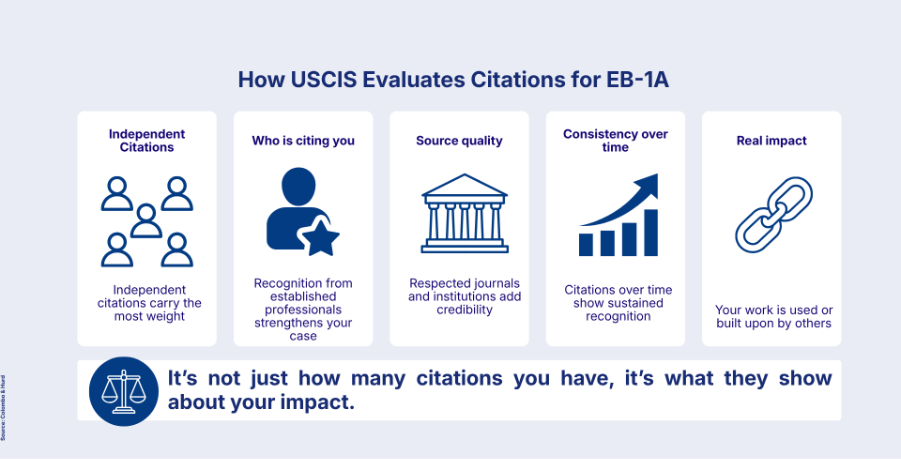
How USCIS Evaluates Citations in Context
Citation counts mean very different things depending on your field. A total of 200 citations might be exceptional for a legal scholar or philosopher. In molecular biology, that same number may reflect an early-career record still in development. The number alone tells USCIS very little.
What matters is how your citation record compares to others in your specific field, at a similar stage of their career. Attorneys building strong EB-1A cases look at journal impact factors, how your publication volume compares to leading researchers in your area, and whether the citations come from independent researchers rather than your own team. That context is what turns a list of numbers into a compelling argument.
This is especially true for petitioners in humanities, social sciences, applied research, or newer interdisciplinary fields, where citation volumes are naturally lower. A petition that explains the standards of your field and shows where your record stands within those norms will always be more persuasive than one that just hands USCIS a number and hopes for the best.
What If My Citation Count Is Low?
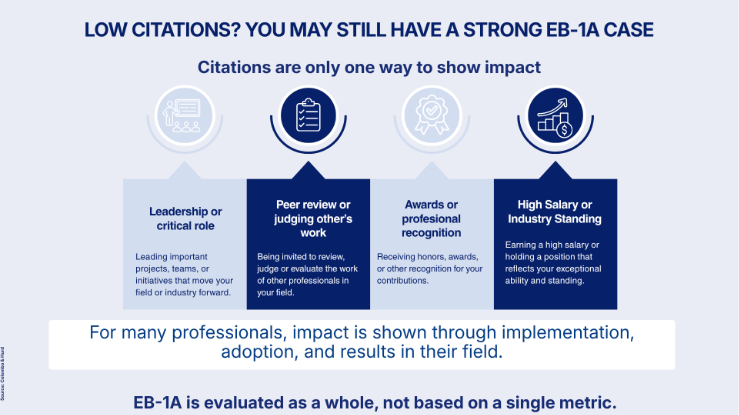
If you are a researcher, scientist, or academic and citations are relevant to your case, a limited citation record does not close the door on EB-1A. To qualify, you need to meet at least three of the 10 USCIS criteria, and citations are only directly relevant to two of them. That leaves plenty of room to build a strong case through other evidence. The alternatives listed below are some of the most commonly used, but they are not exhaustive:
Peer review service. Being invited to review manuscripts for peer-reviewed journals or sit on grant review panels is strong evidence that others in your field trust your expertise. Invitation letters from journal editors and a log of your review activity are typically used to document this.
Awards and professional recognition. Receiving honors, prizes, or other formal recognition for your contributions, whether from institutions, professional associations, or nationally recognized conferences, can satisfy this criterion even if the award was limited to early-career professionals or a specific subfield.
Leadership or critical role. If your current position, a principal investigator role, a senior scientist post at a leading research institute, or a faculty position at a highly ranked university, is the kind of role that only someone at the top of the field would hold, that employment is itself evidence of extraordinary ability. Industry research roles at distinguished companies can satisfy this criterion as well.
High salary or industry standing. Earning a salary significantly above what others in your field and location earn is a standalone criterion. Objective wage data, contracts, and pay statements are typically used to document this.
Other criteria that can strengthen a case include editorial board membership, media coverage of your work in professional or trade publications, and membership in associations that require outstanding achievement to join.
Many applicants with strong careers have limited citation counts, especially those early in their careers, those working in applied or industry settings, or those whose work has been widely adopted in practice but rarely cited in academic papers. Citations are one way to show impact. They are not the only way.
Final Merits: What Actually Decides the Case
Meeting at least three EB-1A criteria is the first step. USCIS still reviews the full record to determine whether the evidence, taken together, shows sustained national or international recognition at the top of the field. This second stage, known as the final merits determination, is where the strength of your overall profile matters most, and where weak evidence across multiple criteria can undermine an otherwise complete petition.
The case is reviewed as a whole, not as a checklist. A single highly cited publication can be compelling, but without continued activity or recognition, it raises concerns. USCIS is looking for a pattern of achievement over time, not an isolated result.
The core question is simple but demanding: have you built a recognized reputation in your field, and does the evidence show it consistently? Citations, publications, roles, and awards all contribute to that answer, but none of them stand alone.
Common Myths About EB-1A Citations
There is a lot of misinformation online about what citations actually do in an EB-1A case. These are the ones we hear most often.
Myth 1: You need a high citation count to apply.
Citation count is one data point that can support your case, not a requirement. USCIS does not set a minimum, and a high number means very little without context. An applicant with 300 citations in a field where 50 is the norm is in a stronger position than one with 1,000 citations in a field where 5,000 is average. What matters is where your record stands relative to your peers, not the number itself.
Myth 2: More citations always means a better case.
Volume without context does not automatically strengthen a petition. USCIS looks at where citations come from, not just how many there are. Independent citations from researchers with no connection to you carry more weight than self-citations or references from close collaborators. A focused record of citations across multiple publications from respected voices in your field will often be more persuasive than a high total built on a single paper or a narrow circle of colleagues.
EB-1A Approval Case Examples
Strong EB-1A cases are not defined by a single type of evidence. What matters is how clearly the record shows recognition and influence within a field. The examples below illustrate how different profiles can meet that standard.
Endocrinologist and Researcher
An EB-1A approval was granted for an endocrinologist and metabolic disease researcher recognized for his work in treating conditions like diabetes and obesity. His career includes peer-reviewed publications, original research, and memberships in selective professional organizations, showing consistent recognition in his field.
His work has helped improve both research and patient care, shaping how metabolic diseases are studied and treated. In his home country, his contributions were honored with a commemorative sculpture recognizing his impact on the medical community.
This approval shows how a strong record of scientific achievement, along with ongoing work with U.S. institutions, can meet the EB-1A standard. It also highlights the value of research that uses technology and data to improve treatment and patient outcomes.
Event Producer
One applicant in entertainment and cultural event production had organized large-scale festivals and international events across Latin America. Although his work showed clear commercial success, USCIS issued a Request for Evidence (RFE) questioning whether his achievements met the EB-1A standard. Concerns focused on the recognition of his awards and whether his productions qualified as artistic displays.
The strength of the case came from how the evidence was presented. Salary data placed his earnings well above industry norms, while expert letters explained the scale and reach of his events. Additional documentation established their cultural significance and clarified how large-scale productions fit within the regulatory framework.
The approval reflected the overall influence of his work, rather than any single category of evidence.
Sports Coach
Another case involved a professional whose career combined teaching, research, and athletic coaching over several decades. USCIS raised questions about how these areas fit together and whether the evidence reflected a single field of expertise.
The response to the RFE addressed this directly. It showed how physical education, sports science, and coaching operate as a unified discipline. Supporting materials demonstrated that his training programs produced athletes who advanced to collegiate and professional levels, while documentation of his affiliations confirmed that they required significant achievement.
Once the connections were clearly established, the record showed sustained recognition, and the petition was approved.
Public Health Innovator
A physician working in rural Africa developed a model to deliver healthcare to underserved communities. Over time, aspects of this approach were adopted more broadly and referenced in larger public health efforts.
In the RFE, USCIS questioned whether these contributions met the standard for “original contributions of major significance.” The response focused on how the work was implemented and expanded. Evidence showed adoption at scale, along with recognition from independent organizations and institutions.
The approval was based on demonstrated impact, supported by clear documentation of how the work was used and its broader influence.
Frequently Asked Questions
How many citations do I need for EB-1A? There is no official minimum. Benchmarks vary widely by field. What looks competitive in engineering may be well below average in molecular biology. That is exactly why an attorney needs to evaluate your record against what is normal in your specific discipline before drawing any conclusions.
Can I qualify for EB-1A without many citations? Yes. Citations are only directly relevant to two of the 10 EB-1A criteria. If you can satisfy at least three criteria through other evidence, you can build a strong case even with a limited citation record.
Do self-citations count for EB-1A? Typically, a citation only carries weight when an independent researcher, with no connection to you or your team, finds your work valuable enough to reference. The more of those you have, the stronger your case.