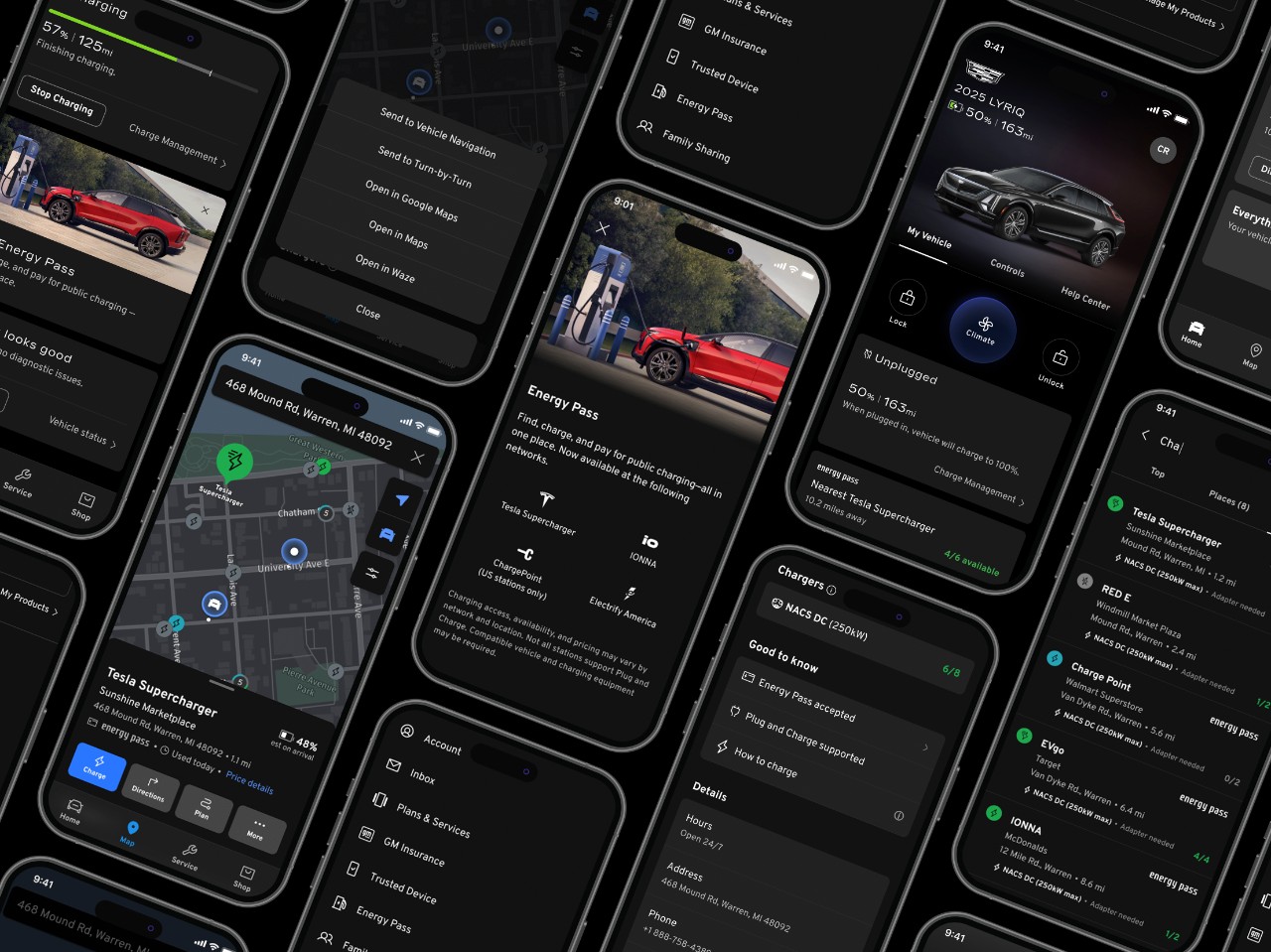

GM Energy Pass is integrated into owners’ existing apps like MyChevrolet, MyCadillac or MyGMC.
As much as we cover the technical details of new electric vehicles week-to-week, there’s another major element (and major barrier) to folks actually taking the plunge: infrastructure. Public fast-charging is a labyrinth of apps, payments and compatibility issues, and General Motors announced this week its latest effort to try and make everything a little bit easier. Covering 70% of all DC fast-charging stations and networks in the United States, GM Energy Pass is supposed to make living with an EV less frustrating by simplifying the charging experience.
Using Energy Pass, which is built into GM’s existing owner apps, you won’t have to go through a smorgasbord of other charging apps on a long road trip, for example. Instead, you can use this single solution when you go to Electrify America, Ionna, or a Tesla Supercharger station. In time, Chargepoint and EVgo will come into the fold. The automaker is working on bringing other DC fast-charging providers and locations into the fold, so that 70% should (hopefully) inch toward complete coverage in the coming months.
Ionna and Tesla, for their part, offer Plug and Charge capability as well. That way, all you have to do is plug in when you need to rejuice, and you won’t have to pull your phone out or fiddle with payments at all. P&C just bills whichever payment method you have on file in the Energy Pass app. The MyChevrolet/MyGMC/MyCadillac app will also tell you when you look up specific charging stations whether they support Energy Pass, whether they support Plug and Charge and other important information like charger availability.
There is a slight caveat with Plug and Charge (at least for now): GM plans to add the functionality for ChargePoint this summer. If you’re looking to charge at a Tesla Supercharger, it only applies to vehicles with native NACS ports. That includes the Cadillac Optiq and 2027 Chevrolet Bolt right now, but the automaker is rolling out onboard NACS charging ports to its full 2027 EV lineup, while other NACS-equipped vehicles will get it through an over-the-air update later this year.
If you own more than one GM vehicle across different brands, GM says you’ll only need to use one app for all your EVs. So, if you have a Chevrolet Equinox EV and a Cadillac Lyriq, for example, you’ll be able to get to both through the app for whichever vehicle you enrolled first (if it’s the Equinox, you’d use the MyChevrolet app).

GM also touched on Vehicle-to-Grid (V2G) integration
A sort of north star for electric vehicle adoption isn’t just zero-emissions driving, but a potential solution for electrical grid balancing. GM’s announcement also included more details on its bidirectional charging capability, to which the automaker has 250,000 such vehicles on the road. Right now, it’s working with Pacific Gas & Electric (PG&E) in California and DTE Energy in Detroit to leverage bidirectional charging into a broader Vehicle-to-Grid (V2G) system, built upon a standardized communication framework among vehicles and electrical grids.


GM put out an open letter to utility providers and regulators to get on board, as a crucial part of grid modernization. GM Energy as well as other home and commercial energy storage solutions like Tesla sell equipment to power homes in the event of a power outage. That said, EVs also have relatively large batteries with computers onboard that can supply power across homes and neighborhoods when demand calls for it, or when there’s a major long-term power outage.
PG&E says that its goal is to have more than 52,000 households in GM’s energy ecosystem into the grid balancing program by the end of the decade.
While the situation around EV battery technology and charging has notably improved over the past few years, there’s still plenty of room to keep going…as Tommy discovered with his Fiat 500e below: