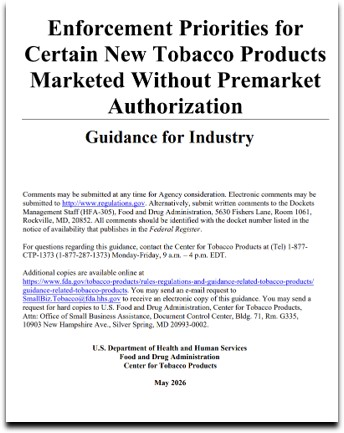
On May 8, 2026, the U.S. Food and Drug Administration (FDA) issued final guidance describing how the Agency intends to prioritize enforcement for certain unauthorized electronic nicotine delivery systems (ENDS) and oral nicotine pouch products marketed without premarket authorization. The guidance is effective immediately and replaces FDA’s prior April 2020 ENDS enforcement-priorities guidance.
Critically, the new guidance does not legalize unauthorized nicotine products or create a safe harbor based on a pending PMTA or timely submission under a prior compliance deadline. Instead, FDA reiterates that new tobacco products sold or distributed without premarket authorization remain illegally marketed, while making clear that lower-priority treatment depends on the product’s current application status. This fits within a broader enforcement strategy targeting illicit tobacco products, illegal imports, counterfeit and misdeclared products, and actors that fail to comply with basic premarket authorization requirements.
The Threshold Test: Accepted and Filed, Not Just Submitted
Under the new guidance, current application status—not timely submission under a prior deadline—is the operative test. For unauthorized ENDS and oral nicotine pouch products, FDA generally does not intend to prioritize enforcement of the premarket authorization requirement when the product fits into one of the following application-status categories:
- Accepted-and-Filed PMTA: the product is subject to an application submitted on or after November 4, 2021, that has been accepted and filed; or
- Qualifying Supplemental PMTA: the product is subject to a qualifying supplemental PMTA (sPMTA) for a modified version of an already-authorized product, and the sPMTA has been accepted and pending for more than 180 days.
For non-tobacco flavored ENDS products, FDA further makes clear that the application must include data necessary to evaluate whether the product is appropriate for the protection of the public health (APPH). Put differently, a non-tobacco flavored ENDS product must satisfy both the relevant application-status prong and FDA’s flavored-ENDS data-sufficiency requirement.
Taken together, the guidance indicates that the relevant question is not whether a manufacturer submitted a PMTA, received an acceptance letter, or met an earlier compliance deadline, but whether the application qualifies under FDA’s current post-November 2021 acceptance-and-filing framework. As a result, a PMTA submitted before the PMTA final rule took effect in November 2021, as discussed below, does not appear to qualify for lower enforcement priority merely because FDA accepted or filed it under the prior, pre-final-rule review framework.
Acceptance vs. Filing
The guidance’s “accepted and filed” language is a term of art. Acceptance review and filing review are separate steps in the multi-phase PMTA review process:

In acceptance review, FDA conducts an initial screen to determine whether the PMTA may be accepted for further review. FDA may refuse to accept an application if, for example, it does not comply with applicable format requirements, is not administratively complete because it does not appear to contain required information — such as properly completed FDA forms, labels, and environmental assessments for each SKU — does not pertain to a tobacco product subject to FDA’s tobacco authorities, or may otherwise be refused under 21 C.F.R. § 1105.10. If FDA accepts an application, it issues an acceptance letter confirming the submission tracking number (STN) for each SKU.
Filing review is the next threshold step. After accepting a PMTA, FDA evaluates whether the application contains enough information to permit substantive scientific review. FDA may refuse to file an application if it lacks required information under the FD&C Act or 21 C.F.R. Part 1114, omits substantive information on key health-risk or behavioral issues, contains a false statement of material fact, or fails to satisfy the requirements applicable to supplemental PMTAs or resubmissions. At this stage, FDA looks for information bearing on the APPH standard, including health risks, comparative health risks, abuse liability, expected use behavior, effects on current tobacco product users and nonusers, perceptions and use intentions, and human factors. If FDA files the application, it issues a filing letter, and the application proceeds to substantive scientific review.
For purposes of the new enforcement guidance, the filing determination is critical. An acceptance letter shows that FDA has accepted the application for further review, but it does not, by itself, show that FDA has made the filing determination needed to proceed to substantive scientific review under the current rule.
The New Key Date: November 4, 2021
FDA states in footnote 7 of the guidance that, for purposes of this guidance, “accepted and filed” means the application has successfully completed acceptance and filing review, with threshold determinations indicating that the application contains sufficient information to support scientific or substantive review, and that those acceptance and filing reviews were for an application submitted on or after November 4, 2021 (the effective date of FDA’s PMTA final rule) and subject to 21 C.F.R. § 1114.27(a) and (b).
The PMTA final rule, 86 Fed. Reg. 55300 (Oct. 5, 2021), converted much of the PMTA process into a more detailed regulatory framework by codifying application requirements in 21 C.F.R. Part 1114, including requirements for application content and format, use of FDA-provided forms, acceptance and filing review, substantive review, postmarket reporting, and recordkeeping.
FDA now appears to be drawing a line between applications submitted under the pre-final-rule framework, including applications submitted by the court-ordered September 9, 2020 deemed-product deadline, and applications subsequently submitted under the final rule’s codified requirements. That distinction is reinforced by the final rule itself: FDA stated in 2021 that it would not retroactively apply new acceptance and filing criteria to PMTAs submitted before the rule became effective, even though the information required by the rule remained important to substantive review. 86 Fed. Reg. 55300, 55396 (Response 146).
This is why the November 4, 2021 cutoff matters. Applications submitted before the PMTA final rule became effective may have been accepted or filed under FDA’s earlier review practices, but they were not submitted under the codified Part 1114 acceptance-and-filing framework that FDA now invokes in the new enforcement policy. As a result, PMTAs submitted by the September 9, 2020 deadline—even if accepted or filed at the time, and even if still pending because of litigation, remand, or another procedural posture—do not appear to qualify for lower-priority treatment under the accepted-and-filed prong unless the product is now tied to a later qualifying application submitted on or after November 4, 2021, or, where the original product has received a marketing granted order, to a qualifying sPMTA. For synthetic nicotine products, the analysis is slightly different because the May 14, 2022 application deadline fell after November 4, 2021. But timeliness alone still does not control. A synthetic nicotine ENDS or pouch product would also need to satisfy the same requirements to qualify for lower enforcement priority.
For non-tobacco-flavored ENDS, FDA adds a separate data-sufficiency requirement: FDA must have determined that the application includes scientific data necessary to evaluate whether the product is appropriate for the protection of the public health (APPH). The new enforcement guidance does not prescribe a specific study design, but it makes clear that applications containing relevant studies, data, and evidence are more likely to provide the information FDA needs to assess the statutory standard. FDA’s March 2026 Draft Guidance on flavored ENDS PMTAs provides additional context, describing a risk-proportionate APPH framework that weighs potential adult benefit against youth risk and generally expects evidence of added adult benefit compared with tobacco-flavored ENDS, particularly for flavors with higher youth-appeal concerns, along with youth-mitigation measures such as age-gating device access restrictions.
What Is a Supplemental PMTA?
The guidance also refers to a supplemental PMTA, or sPMTA, but that term should not be confused with an ordinary pending PMTA. An sPMTA is a post-authorization submission available to an applicant that has already received a marketing granted order (MGO) and seeks authorization for modifications to that already-authorized product. Under 21 C.F.R. § 1114.15, an applicant with an MGO may submit a supplemental PMTA instead of a full standard PMTA when the modification creates a new tobacco product but the application can efficiently rely on the original authorized product’s PMTA record. The sPMTA must include new information about the modifications that create the new product, but the applicant may satisfy other requirements by cross-referencing applicable content from the previously submitted PMTA. This is why FDA’s enforcement guidance treats sPMTAs differently: they are tied to an already authorized product that FDA has evaluated under the APPH standard.
Products Still at Higher Enforcement Risk
FDA says products that do not fall within the guidance’s lower-priority categories are subject to prioritized enforcement. Even products that otherwise meet the application-status criteria can remain enforcement priorities if they have elements FDA views as presumptively appealing to underage users, such as cartoon-like fictional characters, designs that disguise the product’s nature as a vaping product, or products resembling a children’s toy, phone, or gaming platform. Although FDA is withdrawing the 2020 ENDS enforcement-priorities guidance, it notes that the prior guidance remains useful background on youth-targeted ENDS products and youth-access concerns.
FDA also will consider whether a product presents a significant public-health or safety concern greater than that generally presented by ENDS or nicotine pouch products. Examples include high nicotine content, serious adverse experiences, a larger number of unexpected adverse experiences compared with authorized products, lack of child-resistant packaging where required, or potential fire hazards.
In other words, a product’s qualifying application status may reduce enforcement priority, but it will not insulate a product with youth-appealing design, problematic marketing, high nicotine content, adverse-event concerns, or other risk factors.
FDA’s Broader Enforcement Message
FDA’s public announcement accompanying the guidance makes clear that the Agency remains committed to combating illicit tobacco products and views the black market as undermining the regulatory framework by exposing consumers to products that have not undergone scientific review. The guidance therefore should not be read only as a pathway for some pending products to move into a lower-priority enforcement posture; it also identifies the products and conduct most likely to remain enforcement priorities, including products with no PMTA, incomplete or deficient applications, applications that have not been filed, pre-final-rule applications that do not meet the guidance’s definition, applications that have received negative action, products with youth-appealing or safety-risk features, counterfeit or misdeclared products, and products entering through unlawful import channels. Consistent with that focus, FDA says it will continue an aggressive strategy targeting the most deceptive and dangerous products, worst actors, and egregious conduct, including by working with the U.S. Department of Justice, Customs and Border Protection, and other federal agencies to seize and destroy illegal products at the border.
A Forthcoming FDA Public List and Likely Conflicts with State Directories
FDA says it will create and maintain a public-facing webpage identifying manufacturers and associated products that FDA generally does not intend to prioritize for enforcement under the guidance. FDA recommends that manufacturers with pending applications in scientific review who want to be included should contact their regulatory health project manager and authorize the relevant products to be made public.
This list could become an important due-diligence tool for retailers, distributors, wholesalers, importers, payment processors, insurers, and other commercial partners. But it should not be treated as an authorization list. FDA states that providing information for the list does not guarantee that FDA will refrain from enforcement against a particular product, and that falling within the lower-priority policy has no bearing on whether the product is likely to receive premarket authorization.
The public list also could create significant marketplace confusion because it likely will not align with the growing number of state PMTA-related product directories, which use different eligibility criteria than FDA’s new lower-priority framework. Many state directory laws allow products to be listed for state-law sale if they have FDA authorization, are subject to a PMTA timely submitted by the September 9, 2020 deadline that remains under FDA review or are subject to an FDA denial that has been judicially stayed or vacated. FDA’s new guidance, by contrast, does not lower enforcement priority merely because a product is tied to a timely September 2020 PMTA. As a result, FDA’s federal list may look substantially different from state directories that rely on historical timeliness, pending judicial review, or stayed denials, meaning a product may appear on a state directory for purposes of lawful sale under state law but not appear on FDA’s lower-priority enforcement list.
Conclusion
FDA’s new guidance marks a meaningful shift in how the Agency intends to prioritize enforcement for unauthorized ENDS and oral nicotine pouch products, but its practical impact remains uncertain. Much will depend on implementation. It remains to be seen how aggressively FDA will use this policy at the border, whether the forthcoming public list will meaningfully affect retailer and wholesaler behavior, and whether the guidance will reduce the availability of illicit or unauthorized products in the marketplace. It also remains unclear how FDA’s list will interact with state PMTA-directory laws, many of which use different eligibility criteria and may include products that do not qualify for FDA’s lower-priority enforcement list.
For now, the guidance gives industry a clearer view of FDA’s enforcement priorities, but not a legal safe harbor.
Because this is final guidance, there is no fixed comment deadline. FDA will accept comments at any time for Agency consideration, but comments would inform potential future revisions rather than delay the guidance’s immediate effect. Stakeholders should nevertheless consider commenting on key implementation issues, including how the new post-November 2021 application-status framework will affect pending applications, flavored ENDS products, import controls, retail compliance, and areas where the policy may create uncertainty, unintended marketplace disruption, or conflict with state directory laws.